Born Wild in the Amazon
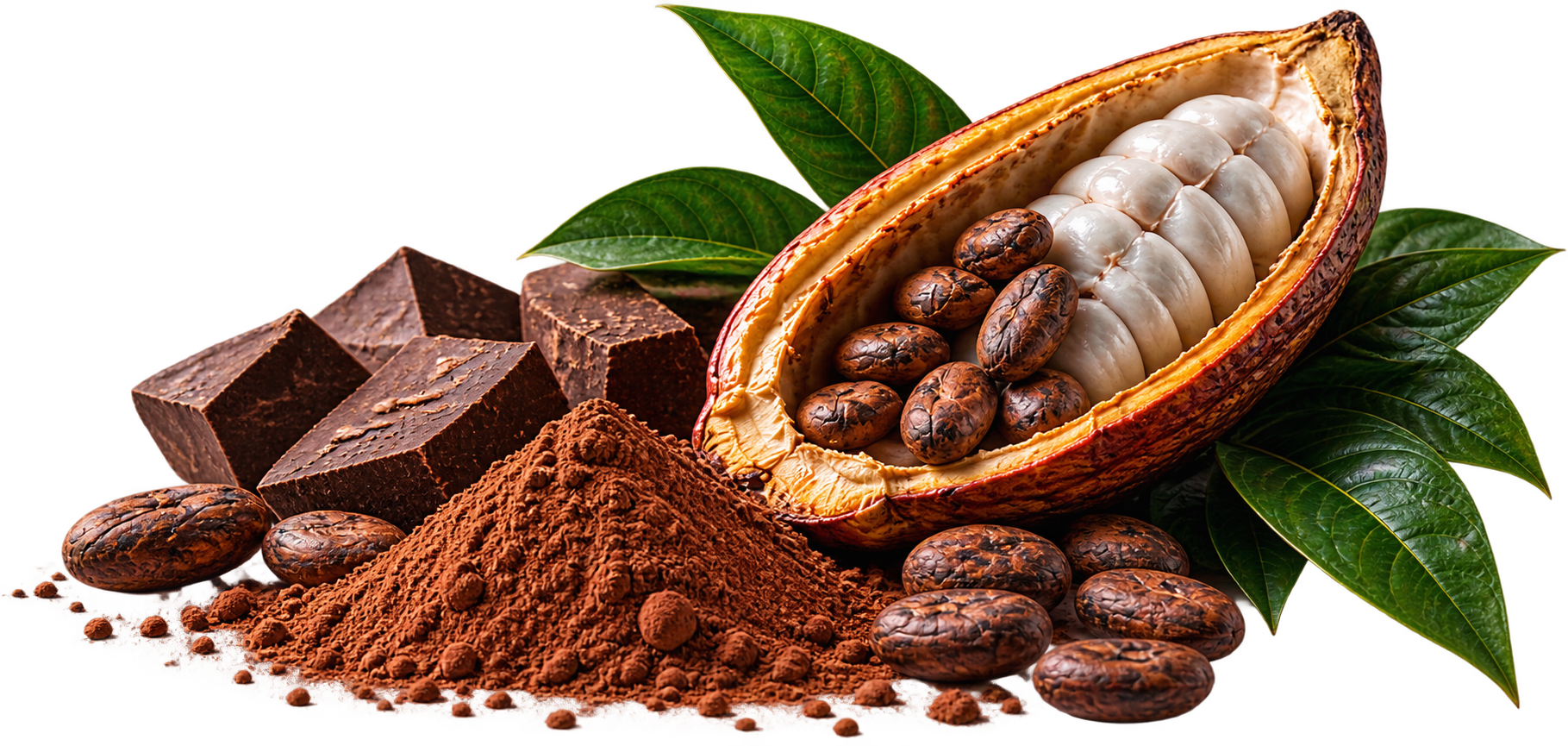
Cacao began as a wild tree in the upper Amazon basin — Ecuador, Peru, Colombia, Brazil — before spreading across South America and the Caribbean. It still grows only in the narrow band within 20 degrees of the Equator, and nowhere else on earth.
We source our beans from small artisan farms, primarily in Ecuador and the Caribbean, where growers have nurtured these trees for generations. A single tree bears for 25 to 35 years, often longer. Pods appear year-round, but the great harvests come twice: a main crop from March to June, and a second significant crop from October through February.
Flavor Is Made, Not Found
Everything begins with fermentation. The ripe pods are slit open and the seeds, still wrapped in their sweet white pulp, are left to ferment — the step that builds flavor, color, and nutrient character before a single bean is ever roasted.
Then the beans are dried in the native sun. Sorted. Blended. Roasted to round out the flavor. Cracked and winnowed to lift away the shell. The nibs are ground into a smooth, glossy paste, met with a few grains of sugar, conched to refine the texture, and finally tempered — coaxing the cocoa butter into its ideal crystal structure.
Every step writes itself into the finish: deep and dark, with notes of red wine, smoke, and earth drawn from the terroir it grew in.
Nothing Stripped Out
Cacao is rich in phytochemicals — the flavonoids catechins, epicatechins, procyanidins, and anthocyanins, along with theobromine, the compounds researchers have studied for their role in cellular health.
Most commercial cocoa is alkalized, or “Dutched” to soften its color and taste. It also strips out the very phytochemicals that make dark chocolate worth eating. We never alkalize. Not once, not at any stage.**
An Honest Word About Fat
Cocoa butter is roughly 60% stearic acid — a saturated fat repeatedly shown to be neutral on total and LDL cholesterol. Palmitic acid is the remaining saturated fat in chocolate that carries the metabolic burden. Ecuadorian and Caribbean cocoa butter are highly valued as they carry more monounsaturated oleic acid and less total saturated fat than typical West African cocoa that makes up 70% of the world’s supply. (Learn more on saturated fats and the importance of origin below)
Of the approximately 6 grams of saturated fat in a serving of our organic dark chocolate, roughly 3.5 grams are stearic acid. Only about 2.5 grams are palmitic.
Q2 Nutra Bars
72% organic Ecuadorian and Caribbean dark cacao. Artfully and intentionally produced for delicious nutrition.
Not All Saturated Fats Are Equal
Where does saturated fat actually come from in Chocolate:
In a 72% bar, essentially all the fat is cocoa butter, and it enters from two doors:
- Intrinsic — cocoa liquor is roughly 52–55% cocoa butter by weight. At 72% cocoa solids, that alone contributes ~28–30 g fat per 100 g.
- Added — most 72% recipes add 8–14% free cocoa butter for smoother texture, proper flow during production, and a clean melt.
Cocoa Butter’s Unique Fat Profile
Cocoa butter is approximately 57% to 64% saturated fat, but its major saturated fats are not identical in how they affect the body. Its principal fatty acids are:
- Stearic acid: Approximately 24% to 37%
- Palmitic acid: Approximately 24% to 30%
- Oleic acid: Approximately 29% to 38%, the same monounsaturated fat found in olive oil Cocoa butter’s distinctive structure gives chocolate its firm snap at room temperature and smooth melt near body temperature.
What This Means for Saturated Fat
A 20 gram serving of 72% dark chocolate may contain about 6 grams of saturated fat, listed as 30% of the Daily Value on a Nutrition Facts label.
The cardiology nuance worth putting front and center
A 20 g serving of 72% Chocolate delivers roughly 6 g / 30% saturated fat on the label. But that number is metabolically heterogeneous:
- Stearic (C18:0), 3–3.6 g (70%) of it — repeatedly shown to be neutral on total and LDL cholesterol, unlike palmitic, myristic, and lauric. It’s desaturated to oleic in the liver and is poorly absorbed in SOS/POS configurations supporting a neutral impact.
- Palmitic (C16:0), 2-2.4 g (30%) — this is the genuinely atherogenic fraction that may affect your total and LDL cholesterol.
So the honest framing for a heart patient isn’t “reduce saturated fat,” it’s lower the palmitic fraction and lower total fat load per serving, while preserving the beneficial flavanol dose. That’s a defensible position clinically, though you can’t put it on a label — FDA nutrition labeling makes no distinction between stearic and palmitic.
Two structures dominate. Stearic and palmitic together are 96.6% of all the saturated fat in the bar — everything else is trace. That’s a much cleaner target than most fats give you.
Cocoa Origin Influences the Fat Profile
QNT Wellness origin selection for Q2 Nutra and Cacao Bliss makes a difference in the saturated fat of the cocoa butter. South American butters (Ecuador, Caribbean and Brazil) run measurably higher in Stearic, Oleic and lower in the harder saturated Palmitic fractions than West African or Asian butters; Ecuadorian butter has been reported around 32–35% stearic with elevated oleic. Blending cacao origins shifts the stearic-to-palmitic ratio favorably without giving up on the Flavanol benefits of chocolate.
The Bottom Line on Chocolate Saturated Fats
A 20 gram serving of Q2 Nutra Chocolate may list about 6 grams of saturated fat. However, a substantial portion of that saturated fat is stearic acid, which has a different and generally more neutral cholesterol effect than several other saturated fatty acids. The label still matters, serving size still matters, and individuals with elevated LDL cholesterol or cardiovascular disease should follow guidance from their clinician. But cocoa butter is not nutritionally equivalent to every other dietary source of saturated fat.
Heavy Metals in Dark Chocolate: What We Test and What We Found
Cocoa is a plant, and like every plant it takes up trace minerals from the soil it grows in. Two of those — cadmium and lead — get attention in dark chocolate, and they arrive by different routes.
Cadmium comes from the ground.
It occurs naturally in soil, and cacao trees absorb it through their roots as the pods grow. Nothing about farming practice adds cadmium, and organic certification doesn’t change it — it’s a function of where the beans grew.
Lead mostly arrives after harvest.
Cocoa beans are traditionally dried outdoors, where airborne dust and soil can settle on the shells. That means lead is largely a handling and cleanliness issue, not a soil issue, and it responds to careful drying, storage, and cleaning.
Because 72% dark chocolate contains far more cocoa solids than milk chocolate, it naturally carries more of whatever the cocoa carries. That’s the tradeoff of a high-cocoa bar, and it’s why we test rather than assume.
What our testing showed
Every lot of QNT Wellness chocolate is analyzed by ICP-MS, the same instrument method used in published research on chocolate. The benchmark is California’s Proposition 65 maximum allowable dose level — one of the most conservative reference points applied to food anywhere, and the same threshold used in independent chocolate testing reports. This lot of QNT Wellness organic chocolate falls below all of their standards.
Measured as concentration, the results also sit well inside the limits that actually govern sale. California’s chocolate industry agreement sets warning thresholds of 0.150 ppm lead and 0.450 ppm cadmium for bars in the 65–95% cocoa range; this lot measured 0.020 ppm lead and 0.178 ppm cadmium. The European Union caps cadmium at 0.80 mg/kg for chocolate with 50% or more cocoa solids — this lot is about a quarter of that.
How we keep it there
We treat cadmium and lead as two separate problems, because they are. Cadmium is managed at the source, through origin selection and soil awareness in the regions we buy from. Lead is managed after harvest, through drying and handling standards with our partners. Then we verify both by lot, and we’ll share the Certificate of Analysis for the bar in your hand.